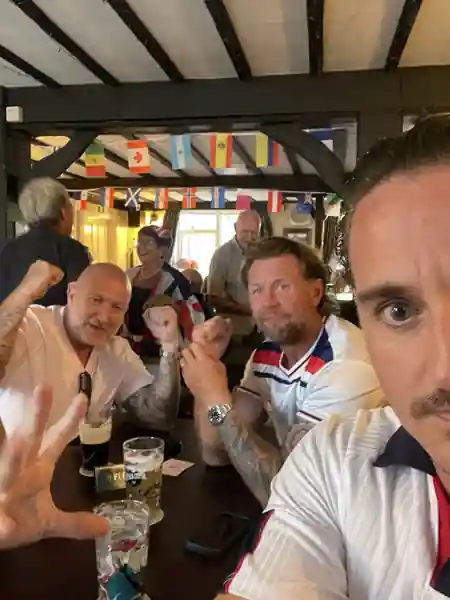
The pub has become our local, although “local” requires a slightly generous interpretation.
It is properly local to one of my friends and local enough to me that the distinction no longer matters. More importantly, it feels local.
It sits in a lovely village and is supported like a village pub needs to be supported: not merely visited when convenient, but used. People know one another. Familiar faces appear. Friends and relatives drift in and out. The place has a life beyond whichever event happens to be on the television.
For England games, going there has become something close to ritual.
There are four of us at the core of it. Good friends, sitting together to watch another group attempt to alter the national mood through football.
Others join us. Family members arrive for part of the evening. Friends appear and disappear. The group expands and contracts around the match.
Against Norway, England needed extra time.
When the winning goal came, it was the high point of the tournament for me.
Not only because England were through to a World Cup semi-final.
For a moment, the whole room wanted exactly the same thing.
One of my earliest clear football memories is Italia 90.
David Platt’s winning goal against Belgium is still lodged somewhere in me: the free kick, the turn, the volley and the sudden release of a match that had almost run out of time.
Then came the semi-final against West Germany.
Then the penalties.
Then tears.
It was the first time football made me cry.
It was not the last.
I was ten years old, old enough to become absorbed by the drama but too young to protect myself from it. England losing did not feel like an interesting sporting outcome. It felt unfair in the way only childhood disappointment can feel unfair.
That tournament helped establish something that has remained ever since.
I do not support England only when they are good.
I support them partly because, each time, there is a possibility that this might be the tournament when everything finally aligns.
History suggests caution.
Football encourages hope anyway.
I would not describe myself as somebody who follows every England friendly with the intensity of a major tournament.
But neither am I a person who remembers football only when flags appear on cars.
I have followed the game throughout my life.
I played it.
I coached it and completed my UEFA B licence.
My son became a professional footballer.
Football has been present in our family not simply as entertainment but as a language, a timetable and a way of understanding people.
It is part of our DNA.
That does not mean treating the game as sacred or pretending it is always a force for good. Football can amplify tribalism, greed, entitlement and some of the worst behaviour people are capable of excusing when they believe loyalty demands it.
But I also believe deeply in its power.
Team sport teaches that your individual ability matters, but only in relationship with other people.
You learn that somebody else’s mistake may become your responsibility.
You learn that your own failure affects the group.
You learn to contribute when you are not the best player, to accept instruction when you disagree, and to continue working when the reward is neither immediate nor guaranteed.
You learn that belonging to something does not mean being its centre.
Those lessons extend far beyond football.
National identity is more complicated than supporting a football team.
A country contains millions of people who do not agree about what it is, what it was or what it should become.
Symbols that feel welcoming to one person can feel excluding to another.
Flags can represent celebration, history, protest, grievance or threat, depending upon who is holding them and why.
Supporting England does not resolve any of that.
Nor should it be used to avoid it.
But during a tournament, England can briefly become smaller and more manageable.
England becomes the people in the pub.
It becomes the four friends who have arranged to meet again.
It becomes somebody arriving late and asking what they have missed.
It becomes family members staying for part of the game.
It becomes people who normally disagree about almost everything sharing the same intake of breath as an attack develops.
This is not national unity in any serious political sense.
Nobody leaves the pub having settled the difficult questions of identity, fairness or belonging.
But something real happens nonetheless.
People place their differences to one side—not permanently, and perhaps not even consciously—and give their attention to the same uncertain outcome.
For ninety minutes, or sometimes considerably longer, the future is shared.
Every tournament begins with a negotiation between memory and hope.
Memory reminds us of penalties, mistakes, missed chances and tournaments that ended just as belief began to feel reasonable.
Hope interprets the same history differently.
It says that coming close means coming closer.
It says that previous disappointment has no authority over the next match.
It says this group might be different.
The optimism is not entirely rational.
That is part of its value.
Much of adult life trains us to manage expectations. We learn to forecast risk, protect ourselves from disappointment and avoid appearing naïve.
Football permits a temporary suspension of that discipline.
We can believe.
Not with certainty, but together.
Against Norway, the optimism survived long enough to become celebration. England won 2–1 after extra time, with Jude Bellingham scoring the winner three minutes into the additional period.
The goal carried more than its practical value.
It justified the evening.
It rewarded the tension.
It turned a collection of people watching a screen into a room sharing a moment.
International football creates heroes unusually quickly.
Players most supporters have never met become vessels for national expectation. Their runs, tackles, decisions and mistakes are discussed as though they are performing on behalf of something much larger than a team.
That can become unhealthy.
The weight placed upon players is often absurd. Admiration turns quickly into entitlement, and entitlement into abuse when the story does not end as supporters hoped.
But heroism in football need not mean perfection.
Sometimes it is simply effort made visible.
It is somebody continuing to make the run.
Somebody accepting responsibility for the penalty.
Somebody recovering after a mistake.
Somebody placing the team above the desire to be seen as its saviour.
Perhaps that is part of what supporters respond to.
We are not only watching skill.
We are watching people attempt something together under pressure.
We recognise the attempt because, in much smaller ways, our own lives require the same thing.
Four days after Norway, England lost 2–1 to Argentina in the semi-final.
England had led through Anthony Gordon, but Argentina scored twice late in the match. The final disappeared almost as soon as it had begun to feel possible.
There was disappointment, obviously.
Football has provided plenty of practice.
But the defeat did not cancel the previous evening in the pub.
It did not remove the winning goal against Norway.
It did not make the optimism foolish.
This is where sporting disappointment differs from ordinary failure.
The result is final, but the experience is not necessarily invalidated by it.
We were there.
We cared.
For a while, the possibility existed.
That matters, even when the ending becomes familiar.
The phrase can sound grander than the reality.
Something greater than yourself might be a nation, a club or a cause.
It might also be four friends agreeing to meet in a village pub.
The value lies not in the scale but in the movement away from the individual.
Football asks us to care about something we cannot control.
It asks us to depend upon strangers.
It reminds us that collective experiences are built from individual acts of attention: turning up, watching, hoping and returning after disappointment.
That is why the pub matters.
We could each have watched at home.
The picture would have been clearer. The seats might have been more comfortable. The commentary would have been easier to hear.
But that would have missed the point.
The match was on the screen.
The experience was in the room.
England did not reach the final.
The country did not become permanently more united.
Whatever differences existed before the tournament remained afterwards.
But for a few evenings, people came together.
The optimism returned.
Friends gathered in the same place.
Families passed through.
A well-supported village pub became our small part of a much larger event.
And when the winning goal went in against Norway, the distinctions briefly disappeared.
Nobody needed to explain what they believed about England.
We were simply supporting England.
Perhaps football cannot bring a country together in the way people sometimes claim.
A country is too complicated for that.
But it can bring a room together.
Sometimes that is enough.